Helping children feel more organized in their bodies so they can participate, learn, play, and thrive.
Have you ever noticed that your child seems to have a hard time sitting still, becomes overwhelmed during everyday activities, struggles with coordination, or has big emotional reactions that seem difficult to explain?
While these behaviors can have many causes, a child’s motor development, body awareness, and ability to respond to sensory information may be part of the bigger picture.
Physical therapy (PT) is often associated with helping children improve strength, balance, walking, and coordination. However, pediatric PT can also support the movement and body-awareness skills that contribute to a child’s ability to participate in daily routines. For some children, a physical therapist may also assess primitive reflexes and determine whether further evaluation or targeted intervention is appropriate.
At Crawl Walk Jump Run Therapy Clinic (CWJR), we look at how children move, interact with their environment, and develop the physical skills they need for everyday life. Understanding the connection between movement, reflex development, and regulation can help families recognize when additional support may be beneficial.
What Is Emotional Regulation?
Emotional regulation is the ability to recognize, manage, and respond to emotions in ways that fit a situation. Children develop these skills over time, and they often need adult support as they learn to handle frustration, excitement, disappointment, changes in routine, and overwhelming experiences.
A child who has difficulty regulating emotions may:
- Become upset quickly when a task is challenging.
- Have difficulty transitioning between activities.
- Struggle to calm down after becoming frustrated.
- Seem constantly on the move or have difficulty settling.
- Become overwhelmed in busy or noisy environments.
- Avoid activities that require balance, coordination, or new motor skills.
- Have difficulty participating in classroom routines, playground activities, or family outings.
These behaviors do not automatically indicate a motor or sensory difficulty. Emotional regulation is influenced by many factors, including sleep, communication, stress, developmental differences, and a child’s environment. However, when regulation challenges occur alongside motor delays, coordination difficulties, or unusual responses to movement, it may be helpful to look at the whole child.
How Are Movement and Emotional Regulation Connected?
Children learn about their bodies and the world through movement. Rolling, crawling, climbing, jumping, balancing, and playing provide opportunities to develop strength, coordination, body awareness, and confidence.
Movement also provides information to the nervous system. The brain receives information from muscles and joints about where the body is in space, as well as information from the inner ear about movement and balance. These systems help children understand their bodies and respond to their surroundings.
When children have difficulty with motor skills or processing certain types of sensory information, everyday activities may require more effort. A child who struggles to coordinate their movements, for example, may become frustrated during playground games or avoid activities that peers seem to manage easily.
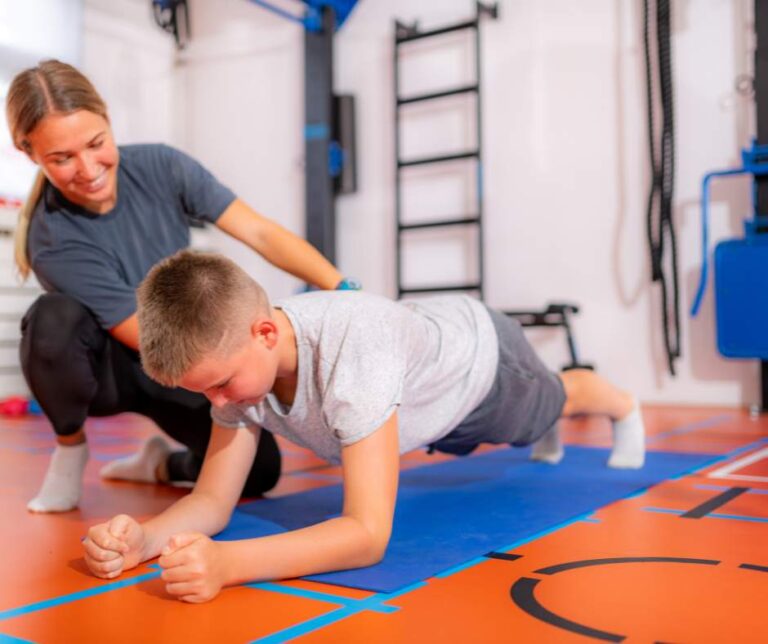
Pediatric physical therapy can help address relevant physical challenges through individualized, play-based activities. Depending on the child’s needs, therapy may focus on:
- Body awareness: Helping children understand where their bodies are in space.
- Balance and coordination: Practicing the skills needed to move safely and confidently.
- Motor planning: Developing the ability to plan and carry out new movements.
- Strength and postural control: Building the stability needed for sitting, standing, and active play.
- Movement confidence: Giving children opportunities to practice challenging tasks at an appropriate level.
- Successful participation: Helping children build skills that carry over into home, school, and community activities.
For some children, structured movement and successful play experiences may also support their ability to engage in activities and recover from frustration. PT is not a stand-alone treatment for every emotional or behavioral concern, but it can be a valuable part of a coordinated approach when motor development contributes to the child’s challenges.
What Is Reflex Integration?
Primitive reflexes are automatic movement responses that are present during early development. They help infants respond to their environment and play a role in early motor development. As the nervous system matures, these early reflex responses typically become less dominant and more voluntary movement patterns develop.
This developmental process is often described as reflex integration.
Some commonly discussed primitive reflexes include:
- Moro reflex: An infant’s automatic startle response to certain stimuli.
- Asymmetrical tonic neck reflex (ATNR): A response associated with turning the head that can influence the position of the arms and legs.
- Symmetrical tonic neck reflex (STNR): A reflex pattern associated with head movement and changes in arm and leg position.
- Tonic labyrinthine reflex (TLR): A reflex pattern associated with head position in relation to gravity and changes in overall body posture.
These reflexes are a normal part of early development. Their presence in infancy is not a problem by itself. If reflex-like movement patterns appear to persist beyond the expected developmental period, or a child has ongoing difficulties with posture, coordination, or functional movement, a qualified healthcare professional can assess whether further evaluation is needed.
It is important to understand that a retained reflex does not automatically explain a child’s behavior, learning difficulty, or emotional regulation challenges. Reflexes should be considered alongside the child’s overall developmental history, neurological status, motor skills, and everyday functioning.
How Can Reflex Patterns Affect Movement?
When a reflex response remains unusually prominent, it may interfere with certain voluntary movements or make some motor tasks more difficult. The effect varies from child to child, and the presence of a reflex alone does not establish the cause of a functional difficulty.
For example, a child may demonstrate difficulty with:
- Coordinating both sides of the body.
- Maintaining a stable posture during sitting or standing.
- Moving smoothly between positions.
- Developing balance and coordination for playground activities.
- Performing tasks that require controlled head, arm, and leg movements.
A physical therapist can assess these movement patterns and determine whether they are relevant to the child’s functional goals. If an underlying neurological or developmental condition is suspected, the therapist may recommend consultation with the child’s pediatrician or another specialist.
How Does Physical Therapy Address Reflex Integration?
When appropriate, a pediatric physical therapist may include reflex assessment and movement activities as part of a comprehensive plan of care. The goal is to improve functional movement and participation, not simply to make a reflex test appear different.
1. Foundational Movement Skills
Activities such as rolling, crawling, transitioning between positions, and reaching may help develop coordination and controlled movement.
2. Core Strength and Postural Control
Exercises and play activities can help children build the stability needed to maintain posture and coordinate their arms, legs, and trunk.
3. Bilateral Coordination
Games that encourage both sides of the body to work together can support skills used during climbing, ball play, dressing, and other daily activities.
4. Balance and Motor Planning
Stepping over obstacles, navigating simple movement courses, and practicing age-appropriate balance activities can help children develop movement confidence and control.
5. Individualized Reflex-Related Activities
If a therapist identifies a relevant reflex pattern, they may recommend specific movement activities based on the child’s assessment, developmental level, and functional goals. These activities should be selected and monitored by a qualified clinician rather than applied as a one-size-fits-all program.
Research on specific reflex-integration protocols and their effects on broad outcomes such as emotional regulation, attention, or academic performance remains limited. For that reason, treatment should be guided by functional needs and measurable goals, with progress reviewed over time.
Can Reflex Integration Help With Emotional Regulation?
Families sometimes seek reflex-integration therapy because their child has frequent emotional outbursts, difficulty focusing, or trouble managing everyday demands. It is understandable to look for an explanation when a child is struggling.
However, reflex integration should not be presented as a proven stand-alone treatment for emotional regulation, ADHD, autism, anxiety, or learning difficulties. These concerns can have multiple causes and may require different forms of support.
Physical therapy may contribute when a child’s motor challenges, body awareness, or movement difficulties are affecting participation and confidence. For example, helping a child improve balance or learn a challenging movement skill may make playground participation less frustrating.
If sensory processing or daily living challenges are also present, occupational therapy may be appropriate. If emotional distress, anxiety, attention concerns, or significant behavioral changes are affecting everyday life, a pediatrician or qualified mental health professional may also be an important part of the care team.
The best approach is individualized and collaborative. The goal is to understand what is making daily life difficult for the child and match the intervention to the actual need.
What Can Parents Do at Home?
Everyday play gives children opportunities to practice movement, build confidence, and develop new skills. You do not need special equipment to encourage healthy motor development.
Consider activities such as:
- Obstacle courses: Walk around cushions, step over soft objects, or crawl through a play tunnel.
- Animal walks: Pretend to move like a bear, crab, frog, or other animal, adapting the activity to your child’s abilities.
- Ball play: Roll, catch, kick, or throw a ball to practice coordination and timing.
- Climbing and playground play: Offer safe, age-appropriate opportunities to climb, step, balance, and explore.
- Movement songs: Use familiar songs with actions to combine listening, imitation, and movement.
- Simple movement breaks: Alternate between active play and quieter activities based on your child’s preferences and needs.
Keep activities playful and manageable. Follow your child’s cues, offer breaks, and avoid forcing movements that cause pain, fear, or significant distress. Do not attempt to provoke primitive reflexes or perform specialized reflex-integration exercises without guidance from an appropriately trained clinician.
Remember that movement activities are not a replacement for an evaluation when a child has persistent developmental or functional concerns.
When Should You Consider a Physical Therapy Evaluation?
You may want to discuss a pediatric PT evaluation with your child’s healthcare provider if your child:
- Has delayed gross motor milestones or difficulty learning new movement skills.
- Demonstrates ongoing balance, coordination, or postural-control difficulties.
- Uses one side of the body noticeably differently from the other.
- Struggles with movements that are expected for their developmental level.
- Avoids physical play because it seems unusually difficult.
- Has movement challenges that interfere with dressing, play, school participation, or daily routines.
- Has a known neurological or developmental condition and needs support with motor skills.
A physical therapist can evaluate your child’s movement, strength, balance, coordination, posture, and functional abilities. If reflex patterns are relevant to the assessment, they may be considered as one part of the overall clinical picture.
If your child loses a skill they previously had, has a sudden change in movement, or develops new weakness or other concerning neurological symptoms, seek prompt medical evaluation rather than waiting for a routine therapy appointment.
How CWJR Can Help
At Crawl Walk Jump Run Therapy Clinic, our team provides individualized rehabilitation services for children and adults with developmental and neurological conditions. Pediatric physical therapy focuses on helping children build the movement skills they need to participate more fully in everyday life.
When a child’s concerns involve several areas of development, collaboration among PT, occupational therapy (OT), speech-language therapy (SLP), families, and other healthcare professionals may help create a more complete plan of care.
Our goal is to understand your child’s strengths, identify areas where support may be beneficial, and develop practical goals that matter to your family.
Wondering Whether Physical Therapy Could Help Your Child?
Contact Crawl Walk Jump Run Therapy Clinic to discuss your concerns and learn about the evaluation process.
Phone: 586-323-2957
Email: patientcare@crawlwalkjumprun.com
Website: crawlwalkjumprun.com
Early conversations can help families understand their options and determine the next appropriate step.