The first year of your baby’s life is filled with exciting changes. Between 6 and 12 months, babies begin developing the strength, balance, coordination, and mobility needed to explore their world in new ways. From rolling and sitting to crawling, pulling to stand, and cruising along furniture, each new movement creates opportunities for learning and independence.
As a parent or caregiver, you may find yourself wondering: Is my baby developing on track? Should my baby be sitting by now? Is it a concern if my baby isn’t crawling? Should I wait a little longer before asking for help?
These are common questions, and it can be difficult to know when a difference in development is simply individual variation and when it may be worth seeking professional guidance.
At Crawl Walk Jump Run Therapy Clinic (CWJR), we encourage parents to pay attention to their baby’s development and ask questions when something doesn’t seem right. You do not need to wait until a delay becomes significant to ask about your baby’s gross motor skills.
Early evaluation can help identify your child’s strengths, determine whether additional support may be beneficial, and provide guidance for encouraging development at home.
Why Is the 6–12 Month Stage So Important?
Between 6 and 12 months, babies make significant progress in gross motor development.
Gross motor skills involve the large muscles of the body that help babies control their heads and trunks, roll, sit, move between positions, crawl or use other forms of mobility, and eventually pull to stand.
These skills build on one another. For example, a baby needs developing trunk control to sit and play, while moving between sitting and other positions requires coordination, balance, and strength.
As babies become more mobile, they gain new ways to reach toys, interact with caregivers, and explore their surroundings.
Gross motor development also gives babies opportunities to practice problem-solving, learn about their environment, and interact with people and objects in different ways.
Every baby develops at an individual pace, and not every child follows the exact same sequence of movement. However, knowing what skills commonly emerge during this stage can help parents recognize when it may be helpful to ask questions.
Gross Motor Milestones at 6 Months
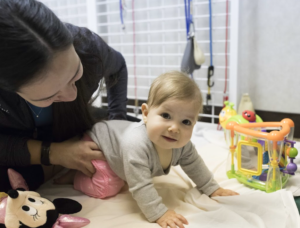
Around 6 months, many babies are developing stronger head and trunk control, becoming more active during floor play, and learning to support themselves in different positions.
According to the Centers for Disease Control and Prevention (CDC), movement milestones most babies can perform by 6 months include:
- Rolling from their tummy to their back
- Pushing up with straight arms when lying on their tummy
- Leaning on their hands for support while sitting
These milestones provide a helpful snapshot of your baby’s developing strength and control.
What Should You Watch For?
At this age, observe how your baby moves during everyday play.
Does your baby lift their head and chest during tummy time? Can they push through their arms to lift their upper body? Are they beginning to participate in rolling and reaching for toys? When placed in a sitting position, can they use their hands to help support themselves?
You may also notice your baby shifting their weight, reaching to one side, or beginning to explore different positions.
Not every baby will perform every movement perfectly at exactly 6 months. However, if your baby consistently struggles with head control, pushing up through their arms, rolling, or using their body to explore, it is reasonable to discuss your observations with your pediatrician or a pediatric physical therapist.
How Can You Encourage Development at Home?
Try supervised floor play while your baby is awake.
- Place interesting toys within your baby’s view to encourage looking and reaching.
- Offer short, comfortable tummy-time opportunities throughout the day.
- Place toys slightly to the side to encourage your baby to turn, reach, and shift weight.
- Give your baby opportunities to explore movement on a safe, firm floor surface.
Always supervise your baby during floor play and follow safe-sleep recommendations, including placing your baby on their back for sleep.
Gross Motor Milestones at 6–9 Months
As babies move through the second half of their first year, they often become more independent in sitting and begin exploring ways to move around.
Around this stage, you may observe your baby:
- Sitting with less support and eventually sitting independently
- Reaching for toys while maintaining a sitting position
- Turning their body to reach objects
- Beginning to move between lying, sitting, and other positions
- Exploring belly crawling, hands-and-knees positions, or other forms of mobility
By 9 months, the CDC identifies two important movement milestones: getting into a sitting position independently and sitting without support.
These skills are important because they allow babies to use their hands for play while maintaining control of their bodies. Independent sitting also provides a new view of the environment and creates opportunities to reach for toys, interact with caregivers, and explore objects.
Is It a Concern if My Baby Isn’t Crawling at 9 Months?
Not necessarily.
Crawling does not look the same for every child, and some babies use different movement patterns to get around. Some crawl on their hands and knees, some move on their bellies, and some use other strategies.
The absence of traditional hands-and-knees crawling alone does not automatically mean a baby has a developmental delay.
However, it is helpful to consider the bigger picture. Is your baby sitting independently? Can they move and reach in both directions? Are they attempting to change positions or find ways to access toys? Do they appear comfortable using both sides of their body?
If your baby is not sitting independently by around 9 months, has difficulty moving between positions, or seems to have limited opportunities to explore movement, talk with your pediatrician and consider whether a physical therapy evaluation would be appropriate.
Rather than focusing only on whether your baby is crawling, look at how they are developing strength, control, and the ability to move through their environment.
Activities to Encourage 6–9 Month Development
1. Reach-and-Play Activities
While your baby is sitting with appropriate support or sitting independently, place a toy just within reach to encourage reaching and returning to an upright position.
2. Floor Play With Toys
Place toys around your baby in different directions to encourage turning, reaching, and shifting weight.
3. Opportunities to Change Positions
Allow your baby time to explore movement on a safe floor surface. Avoid keeping your baby in containers or equipment for long periods when floor play is possible and appropriate.
4. Interactive Play
Talk, sing, and play face-to-face with your baby. These interactions encourage engagement while giving your baby reasons to look, reach, and move.
If a particular activity consistently frustrates your baby or seems physically difficult, a pediatric physical therapist can help you identify ways to make it more appropriate for their current abilities.
Gross Motor Milestones at 9–12 Months
The months leading up to your baby’s first birthday can bring exciting changes in mobility. Many babies begin finding new ways to get around, pull themselves upright, and move along furniture.
Around 9–12 months, you may see your baby:
- Move into and out of sitting more independently
- Explore crawling or another method of mobility
- Move between sitting and hands-and-knees positions
- Begin pulling up to stand using stable furniture
- Practice standing while holding onto support
- Begin moving sideways along furniture, often called cruising
By 12 months, the CDC identifies pulling up to stand and walking while holding onto furniture as movement milestones.
It is important to remember that these are developmental reference points, not a checklist that every child must complete in precisely the same order.
What if My Baby Isn’t Pulling to Stand or Cruising Yet?
If your baby is approaching their first birthday and is not showing signs of moving toward standing or supported mobility, it is reasonable to bring this up with your pediatrician or a pediatric physical therapist.
The concern is not simply whether your baby is standing on a particular date. It is also important to understand the skills leading up to standing.
For example:
- Can your baby sit independently?
- Can your baby move between positions?
- Does your baby attempt to move toward toys or caregivers?
- Can your baby bear weight through their legs when appropriately supported?
- Does your baby use both sides of their body?
- Is your baby making progress over time?
A physical therapist can evaluate these movement patterns and help determine whether your baby would benefit from targeted support.
Does My Baby Need to Walk by 12 Months?
No. Walking independently is not a CDC milestone for 12 months.
At this age, pulling to stand and walking while holding furniture are more appropriate movement milestones to watch for.
Some children begin walking independently around their first birthday, while others need more time. Not walking independently at 12 months, by itself, does not necessarily indicate a delay.
However, if your baby is not yet demonstrating earlier foundational skills, such as independent sitting, attempts to move between positions, or pulling to stand, it is worth discussing the overall pattern of development rather than simply waiting for independent walking.
When Should You Consider Pediatric Physical Therapy?
One of the biggest questions parents ask is, “How far behind does my baby need to be before I should schedule a physical therapy evaluation?”
The answer is that you do not have to wait for a major delay or for your child to miss several milestones before seeking guidance.
If you notice a difference in your baby’s movement that concerns you, it is appropriate to ask questions. A physical therapy evaluation can help determine whether your baby is developing the expected foundational skills, whether a movement pattern needs closer attention, and whether therapy may be beneficial.
Consider discussing an evaluation if your baby:
- Is not rolling by around 6 months or has difficulty with other expected movements
- Has difficulty pushing up through their arms during tummy time
- Is not sitting independently by around 9 months
- Has difficulty moving between positions or reaching for toys while maintaining balance
- Shows little interest in moving toward people or objects
- Is not showing progress toward mobility as the months go by
- Has difficulty bearing weight through their legs when appropriately supported
- Consistently uses one side of their body much more than the other
- Seems unusually stiff or floppy during movement
- Frequently loses balance or struggles with movement tasks that were previously becoming easier
- Has lost a movement skill they previously demonstrated
These observations do not automatically mean your baby has a developmental disorder. They are reasons to ask questions and determine whether further assessment is appropriate.
What if the Delay Seems Very Small?
Even a subtle concern is worth discussing.
For example, perhaps your baby can sit but rarely attempts to move out of that position. Maybe your baby reaches easily with one hand but seems reluctant to turn or reach in the opposite direction. Or perhaps your baby can bear weight through their legs when supported but is not making progress toward pulling to stand.
Any one observation may have several explanations. A pediatric physical therapist can look at the full picture, including strength, balance, coordination, movement quality, and developmental history.
Early evaluation does not mean something is definitely wrong. It means you are gathering information about your child’s development.
Sometimes an evaluation provides reassurance and suggestions for play at home. In other cases, it identifies skills that could benefit from targeted intervention.
When a delay is identified, early support can help families work on relevant movement skills while their baby is actively learning new ways to explore the world.
Why Waiting Can Make It Harder to Know What to Do
It is common for parents to hear that their baby may simply need more time. Sometimes that is true, but waiting without guidance can leave families uncertain about whether their child is progressing as expected.
If you have a concern, you can ask for an evaluation while continuing to encourage development at home. You do not have to choose between giving your baby time and seeking professional advice.
An evaluation can establish a clearer picture of your baby’s current abilities and provide individualized recommendations. If therapy is appropriate, a physical therapist can help your baby practice foundational skills through activities suited to their developmental level.
The American Academy of Pediatrics supports ongoing developmental surveillance at health supervision visits and recommends standardized developmental screening at 9, 18, and 30 months. Developmental concerns identified at any visit should be addressed rather than waiting for the next routine screening appointment.
If your baby has lost skills they previously had, or you notice a sudden change in movement, contact your child’s healthcare provider promptly.
How Pediatric Physical Therapy Helps Babies With Gross Motor Delays
Pediatric physical therapy is designed to help babies develop the movement skills they need to participate in everyday life.
During an evaluation, a physical therapist may look at:
- Head and trunk control
- Strength and postural control
- Rolling and transitions between positions
- Sitting balance and reaching
- Coordination and use of both sides of the body
- Leg strength and supported weight-bearing
- Early mobility and movement toward standing
- The quality and variety of your baby’s movement patterns
The therapist will also consider your baby’s medical history, developmental history, and the concerns you have observed at home.
Based on the evaluation, therapy may focus on strengthening foundational movement skills, improving balance and coordination, practicing transitions, encouraging safe exploration, or helping your baby develop more efficient ways to move.
Parents are an important part of this process. Your therapist can demonstrate activities that fit naturally into daily routines, such as floor play, reaching for toys, or practicing position changes.
The goal is not to force a baby to reach a milestone before they are ready. Instead, therapy helps identify the skills your baby needs and provides appropriate opportunities to practice them.
How Can Parents Support Gross Motor Development at Home?
You do not need expensive toys or a complicated exercise routine to encourage your baby’s movement. Everyday interactions can provide meaningful opportunities to practice.
Make Time for Supervised Floor Play
Give your baby regular opportunities to explore movement on a safe floor surface while awake and supervised.
Floor play allows babies to practice rolling, reaching, shifting weight, and changing positions.
Encourage Reaching in Different Directions
Place a favorite toy slightly to one side or just beyond easy reach. Give your baby time to look, turn, and attempt to reach for it.
Adjust the distance so the activity is challenging but achievable.
Allow Opportunities to Practice Transitions
As your baby develops, allow time to explore moving between positions rather than always placing them directly into a sitting or standing position.
These transitions are important opportunities to practice strength, balance, and coordination.
If your baby has difficulty with transitions, a physical therapist can show you how to encourage them safely.
Offer Safe Opportunities to Explore Standing
As your baby begins pulling to stand, provide access to stable, age-appropriate furniture under close supervision.
Keep the surrounding area clear of sharp edges and unstable objects.
Avoid baby walkers with wheels. They can create safety risks and are not recommended as a way to teach walking.
Follow Your Baby’s Cues
Babies learn through repetition, but activities should remain comfortable and enjoyable.
If your baby becomes tired, distressed, or consistently unable to perform a movement, take a break and adjust the activity.
If you are unsure which activities are appropriate, ask your pediatrician or physical therapist for individualized recommendations.
What if My Baby Was Born Prematurely?
Babies born prematurely may reach developmental milestones later than babies born at the same chronological age.
Healthcare professionals may use a corrected age when considering development, depending on the baby’s history and age.
If your baby was born prematurely or has a medical history that may affect development, discuss the appropriate way to monitor milestones with your healthcare team. You can still seek guidance whenever you have concerns about movement.
Trust Your Instincts and Ask Questions Early
You spend more time observing your baby than anyone else. You may notice small differences in how your baby moves, reaches, rolls, sits, or explores before those differences become obvious to others.
You do not need to diagnose a delay yourself. You simply need to share what you are noticing and ask whether an evaluation would be helpful.
If your baby is between 6 and 12 months old and you have concerns about gross motor development, talk with your pediatrician and ask whether pediatric physical therapy is appropriate.
If your baby is not meeting one or more milestones, the CDC recommends acting early rather than waiting for the concern to resolve on its own.
Early support can help you understand your baby’s needs, learn how to encourage development at home, and determine the next steps that make sense for your family.
How Crawl Walk Jump Run Therapy Clinic Can Help
At Crawl Walk Jump Run Therapy Clinic (CWJR), we understand that parents want to give their children the best possible start.
Our team works with families to identify developmental concerns, evaluate movement skills, and create individualized therapy plans when appropriate.
If you have questions about your baby’s rolling, sitting, transitions, crawling, pulling to stand, or other gross motor skills, we encourage you to reach out.
You do not have to wait until a delay becomes more noticeable to ask for help. A conversation or evaluation can be a helpful first step toward understanding your baby’s development.
Contact Crawl Walk Jump Run Therapy Clinic:
- Phone: 586-323-2957
- Email: patientcare@crawlwalkjumprun.com
We are here to help you understand your child’s movement development and explore the next steps when concerns arise.
Developmental milestones are general guidelines, not a diagnosis. If you are concerned about your baby’s development, consult your child’s healthcare provider or a qualified pediatric physical therapist for individualized guidance.